Understand How Thoughts Take Hold
Learn how language, relational frames, and cultural narratives shape cognitive fusion and reinforce client suffering.
Apply Effective Defusion Strategies
Use ACT-based techniques to help clients create distance from rigid thoughts, reduce shame, and increase psychological flexibility.
Support Values-Driven Change
Guide clients toward actions rooted in meaning and identity, rather than automatic rules or internalized expectations.
About the course
This training invites therapists to step beyond the limits of traditional cognitive models and explore how language, culture, and power shape the inner worlds of our clients. You’ll learn to recognize how thoughts function—not as truths to be corrected, but as linguistic events that can entangle, constrain, or liberate. Drawing from Acceptance and Commitment Therapy, Relational Frame Theory, and post-structural thinkers like Foucault and Deleuze, this course translates complex philosophical ideas into practical clinical skills. Together, we’ll examine how cognitive fusion forms through cultural memes, relational frames, internalized norms, and the “internal panopticon” of self-monitoring. Through case examples, metaphors, and experiential exercises, you’ll learn how to help clients step back from rigid narratives and move toward values-aligned action. We’ll also explore the ethical dimension of cognitive defusion—how shifting our relationship to language can reduce shame, honor lived experience, and validate sociocultural realities that traditional CBT often overlooks. By the end, you’ll have a deeper understanding of how thoughts operate, how suffering is constructed, and how defusion can support clients in building lives that are flexible, meaningful, and self-authored. Learning Objectives 1. Critique the limitations of traditional CBT in addressing sociocultural and identity-based experiences of distress. 2. Analyze the implications of cognitive fusion through a sociocultural and post-structural lens, including its relationship to power, identity, and internalized norms. 3. Define cognitive fusion and defusion within the framework of Acceptance and Commitment Therapy (ACT). 4. Identify common clinical examples of fused thinking and explain how fusion contributes to psychological suffering. 5. Describe how language, cultural memes, and relational frames shape internal narratives and reinforce identity-based fusion. 6. Create original metaphors for cognitive defusion to use in clinical practice.

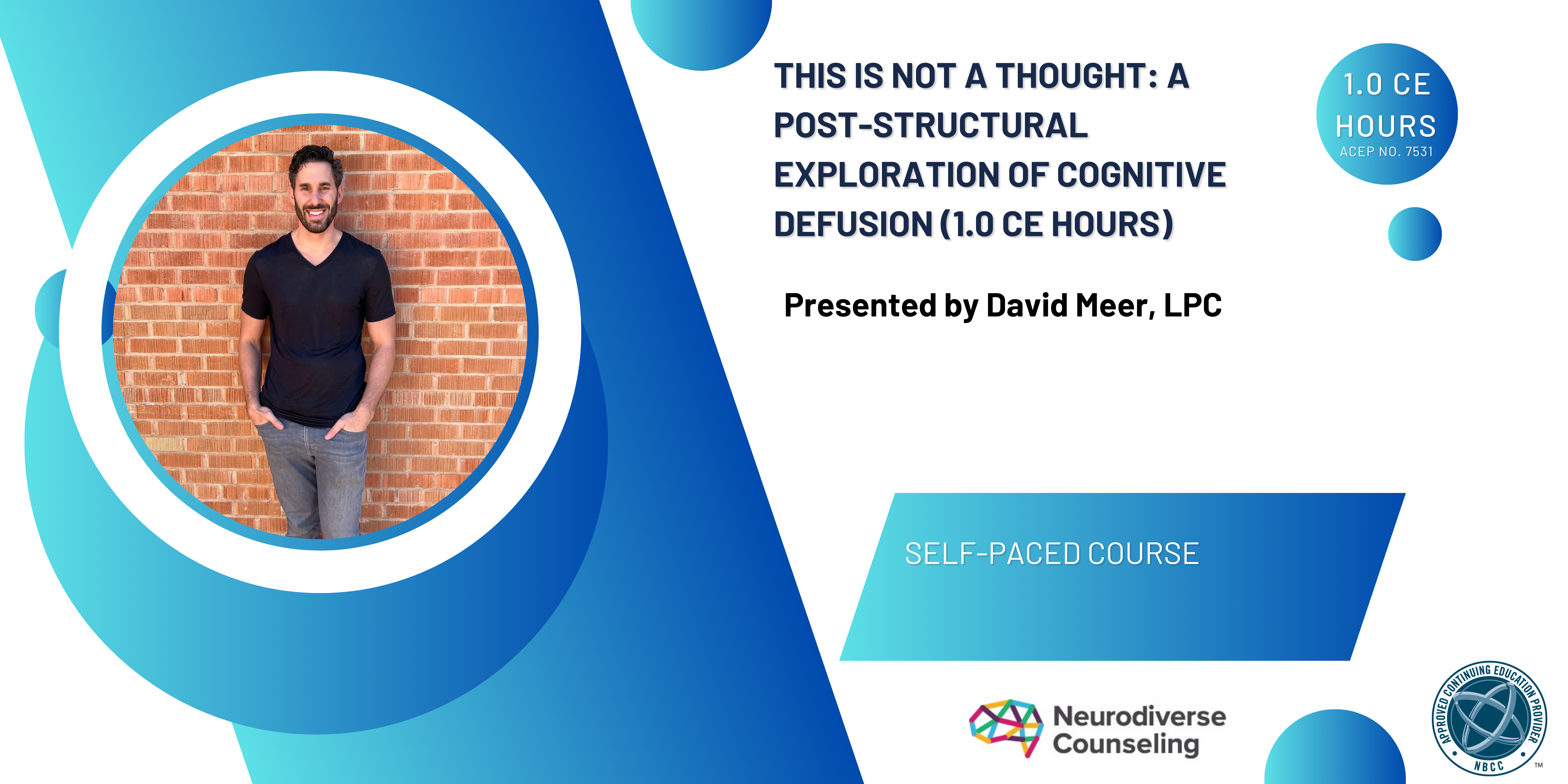
Presented by David Meer
David is a licensed professional counselor with a focus on neurodiversity-affirming care. He leads a group practice dedicated to supporting neurodivergent individuals through inclusive, client-centered approaches. David is passionate about challenging conventional models in mental health and promoting compassionate, equity-driven practices in both clinical work and education.
Curriculum
-
1
Introduction
-
(Included in full purchase)
Course Overview
-
(Included in full purchase)
CE Information
-
(Included in full purchase)
Introduction
-
(Included in full purchase)
Objectives
-
(Included in full purchase)
-
2
Limitations of Cognitive-Behavioral Therapy
-
(Included in full purchase)
Limitations of Cognitive-Behavioral Therapy
-
(Included in full purchase)
Cognitive Behavioral Therapy
-
(Included in full purchase)
Cognitive Behavioral Therapy
-
(Included in full purchase)
Cognitive Behavioral Therapy
-
(Included in full purchase)
Cognitive Behavioral Therapy
-
(Included in full purchase)
Cognitive Behavioral Therapy
-
(Included in full purchase)
Positive Gaslighting
-
(Included in full purchase)
Cognitive Distortions
-
(Included in full purchase)
Cognitive Distortions
-
(Included in full purchase)
Docile Neoliberal Subject
-
(Included in full purchase)
-
3
How the Mind Creates Suffering
-
(Included in full purchase)
How the Mind Creates Suffering
-
(Included in full purchase)
Language
-
(Included in full purchase)
Language
-
(Included in full purchase)
Language
-
(Included in full purchase)
Verbal Delusions
-
(Included in full purchase)
Marvin Minsky
-
(Included in full purchase)
Cubbyholing
-
(Included in full purchase)
Cognitive Fusion
-
(Included in full purchase)
Cognitive Fusion
-
(Included in full purchase)
Relational Frame Theory
-
(Included in full purchase)
Relational Frame Examples
-
(Included in full purchase)
Relational Framing
-
(Included in full purchase)
Relational Frame Examples
-
(Included in full purchase)
Relational Frame Examples
-
(Included in full purchase)
Relational Frame Examples (Homer Simpson)
-
(Included in full purchase)
Relational Frame Examples (Darth Vader)
-
(Included in full purchase)
Relational Frames
-
(Included in full purchase)
Deleuze
-
(Included in full purchase)
Assemblages & Multiplicity
-
(Included in full purchase)
Language as a Machine for Becoming
-
(Included in full purchase)
Deconstructing Thoughts
-
(Included in full purchase)
ACT
-
(Included in full purchase)
-
4
Tools for Clinicians
-
(Included in full purchase)
Tools for Clinicians
-
(Included in full purchase)
Assessing Fusion
-
(Included in full purchase)
Assessing Fusion
-
(Included in full purchase)
The Treachery of Images
-
(Included in full purchase)
The Treachery of Images
-
(Included in full purchase)
Defusion
-
(Included in full purchase)
Leaves on a Stream
-
(Included in full purchase)
Cognitive Defusion
-
(Included in full purchase)
Deconstructing Thoughts
-
(Included in full purchase)
Yes, and …
-
(Included in full purchase)
Tattoos
-
(Included in full purchase)
Sunset Mode
-
(Included in full purchase)
Removing the Panopticon
-
(Included in full purchase)
References
-
(Included in full purchase)
-
5
Assessment
-
(Included in full purchase)
Assessment
-
(Included in full purchase)
Feedback
-
(Included in full purchase)
Deepen Your Clinical Insight Into Thought & Language
Explore how language, culture, and power shape thought. Learn ACT-based cognitive defusion through a post-structural lens to reduce suffering, increase flexibility, and support clients with more affirming, values-aligned care.
$15.00
Neurodiverse Counseling Services: ACEP No. 7531
Neurodiverse Counseling Services has been approved by NBCC as an Approved Continuing Education Provider, ACEP No. 7531. Programs that do not qualify for NBCC credit are clearly identified. Neurodiverse Counseling Services is solely responsible for all aspects of the programs. Neurodiverse Counseling Services 6424 East Greenway Parkway, Scottsdale, AZ, 85254 (480) 531-1076 [email protected]